
Santa Fe County Criminal Court Cases
There is no single local criminal docket. The First Judicial District Court at the Steve Herrera Judicial Complex hears Santa Fe County felony trials, appeals from lower courts, and criminal-record expungement petitions. The Santa Fe County Magistrate Court hears misdemeanors, DWI and domestic-violence matters, as well as first appearances and preliminary hearings in many felony cases. A felony may therefore begin in Magistrate Court and continue under a new District Court case number.
Municipal courts form a third layer. Santa Fe Municipal Court handles petty misdemeanors, DWI, traffic, and city ordinance cases without jury trials. Española and Edgewood also keep city dockets for cases within their municipal jurisdiction. The clerk of the court where a filing occurred is its custodian. The district attorney prosecutes cases but does not keep the clerk's official file.
The official First Judicial District page shows the court and its public services. Its published view makes the local court split easier to understand before choosing a search system.
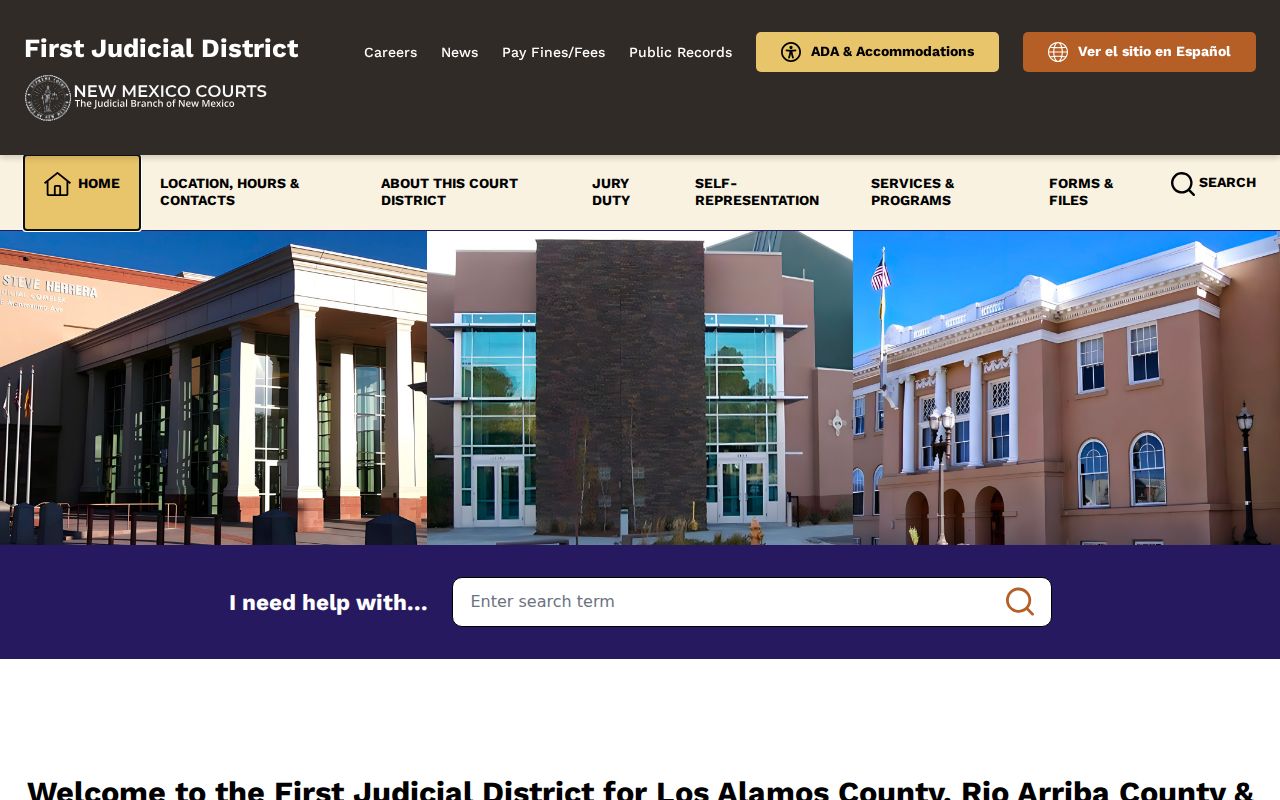
This court is the place to confirm felony filings, judgments, sentences, and allowed copies in Santa Fe County.
Santa Fe County Criminal Court Levels
Choosing the wrong court is a common cause of an empty search. A serious charge may have an early Magistrate Court entry and a later District Court file. A city citation may remain solely in Municipal Court. Federal charges are different again: they belong to the U.S. District Court for the District of New Mexico and do not appear in New Mexico Case Lookup.
| Court | Santa Fe County criminal role | Direct channel |
|---|---|---|
| First Judicial District | Felony trials, lower-court appeals, expungement petitions | 225 Montezuma Ave.; 505-455-8250; weekdays 8 a.m.-4 p.m. |
| Santa Fe Magistrate | Misdemeanors and early felony proceedings | 2056 Galisteo St.; 505-984-9914; weekdays 7:30 a.m.-4 p.m. |
| Santa Fe Municipal | City ordinances, traffic, DWI, petty misdemeanors | 2511 Camino Entrada; 505-955-5070; weekdays 8 a.m.-5 p.m. |
| Federal District Court | Federal criminal charges | PACER or the federal clerk, not the state portal |
Match the case location and number to the court before relying on the result. A District Court criminal number commonly begins with D-101-CR, followed by the filing year and sequence.
Searching Santa Fe County Case Records
New Mexico Courts Case Lookup is the free starting point for electronic summaries. It requires acceptance of the Judiciary disclaimer, does not require registration, and does not supply document images or certified copies. Search narrowly enough to separate people with similar names, then use the court location and case identifier to reach the proper clerk.
- Accept the Case Lookup disclaimer and choose a person-name or case-number path.
- Enter the legal name or exact case number, then narrow the court or case category where the interface allows.
- Open the matching Santa Fe County result and compare the location, filing date, case type, and identifier.
- Read charges, hearings, events, and disposition as separate entries rather than treating the first charge as the final outcome.
- Use re:SearchNM or contact the named clerk when a filed document, older record, or certified copy is needed.
| Field | Type | Required | Use |
|---|---|---|---|
| Name or party | Text | One search path | Add first or middle name to narrow a common surname |
| Case number | Text | Case-number path | Use the full court, type, year, and sequence format |
| Court or location | Filter | No | Separate First District from Magistrate or other locations |
| Case category | Filter | No | Narrow to criminal and other available categories |
| Search | Button | Yes | Runs the chosen query |
The official Case Lookup interface shows the actual statewide public entry point used for this first pass.
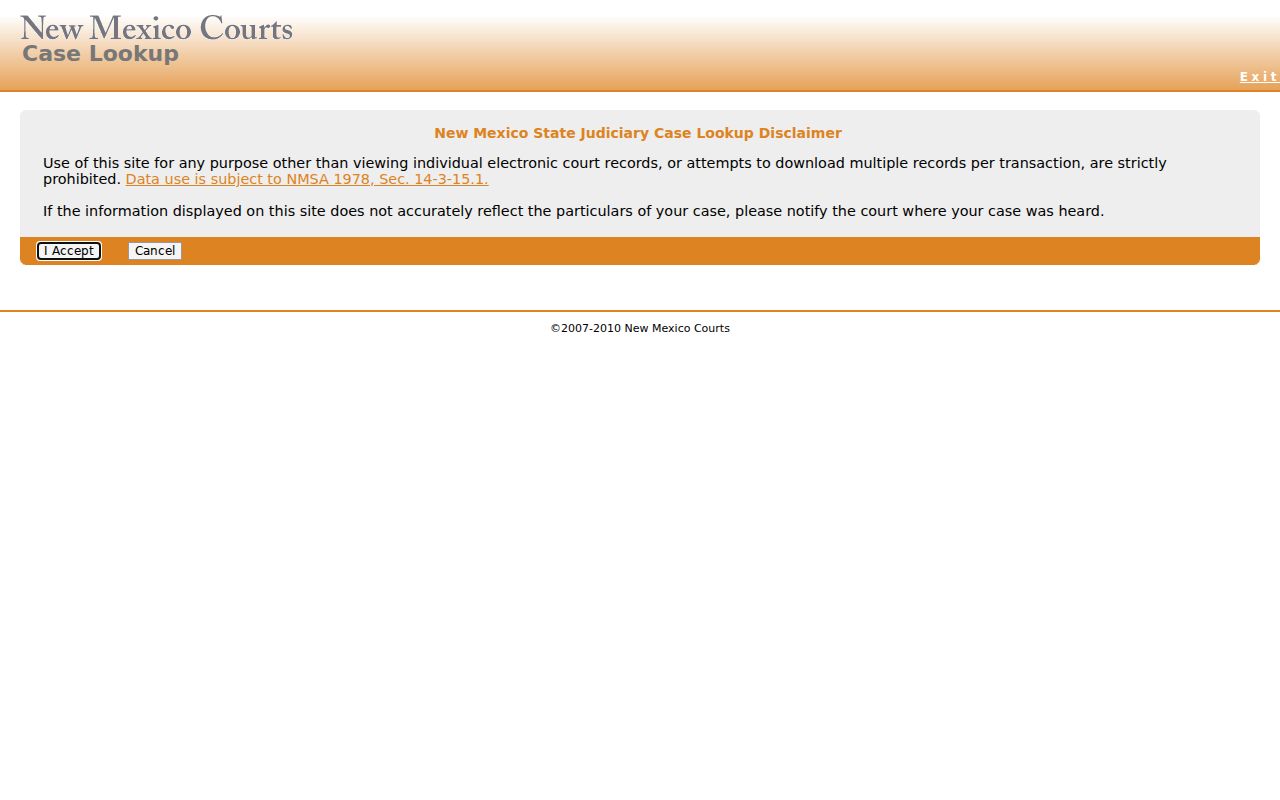
The screen is a summary search, so its value lies in finding the right case and court, not replacing the clerk's file.
Santa Fe County Court Document Routes
Case Lookup has no filed documents. Registered re:SearchNM access can expose allowed filings and images based on the user's tier and the file's security. The service supports cases, filings, and text searches, with filters for party, case number, status, type, filing date, judge, and location. Basic registered access is free, while expanded features depend on the plan and access profile.
A clerk request remains the dependable route for a copy or certification. First District lists public-record email sfedrequests@nmcourts.gov. Published fees are $0.35 per page, $1.50 for certification, and $4 for tape or CD. Records from before 1997 require an older-record request through the Judiciary IPRA portal, email, or clerk counter.
The re:SearchNM portal is the middle layer between a summary search and a direct clerk request.
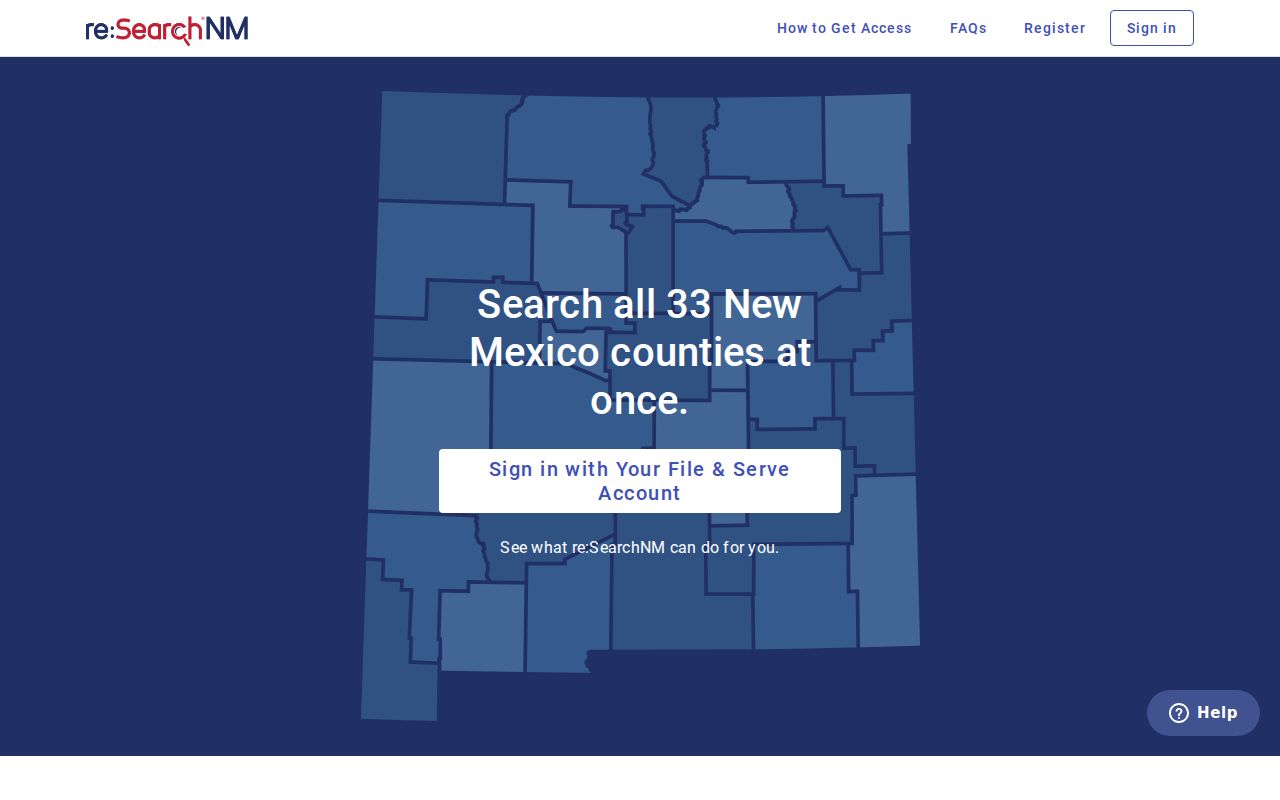
Document access varies by case and user tier, which is why the hearing court remains the final source for a certified Santa Fe County record.
Inside a Santa Fe County Case File
A criminal file records the charge as filed and what the court did with it. It is distinct from the arresting agency's report and the jail's booking record. Search results can show enough data to track a case, but pleadings, orders, and exhibits may require re:SearchNM or a request to the Santa Fe County clerk.
| Case number and court | Identifies the venue, case type, filing year, and sequence. |
|---|---|
| Charging document | Shows the complaint, information, or indictment filed through the court. |
| Charges | Lists description, statute, level, sequence, filing date, and later disposition where available. |
| Docket and hearings | Chronicles filings, appearances, motions, orders, and scheduled events. |
| Parties and counsel | Identifies allowed party roles, attorneys, CAID, judge, and court location. |
| Judgment and sentence | Records conviction, dismissal, acquittal, deferred outcome, sentence, and related financial entries. |
Some re:SearchNM views also show related cases, register-of-actions entries, permitted PDF or TIF documents, payments, credits, and balances. Access to sensitive party details depends on law and user tier.
Santa Fe Municipal Criminal Cases
General Case Lookup has limited municipal coverage. For broader City of Santa Fe records and calendars, use the city's FullCourt public portal. After the disclaimer and public login, searches can run by attorney, officer, party, police reference number, or vehicle plate. The Cases path accepts a docket number. Recent entries may lag.
Payment is a separate action and requires the exact case or citation number plus date of birth. The payment vendor adds 5.95 percent. Paying a balance does not necessarily recall a bench warrant, so call Municipal Court at 505-955-5070 and ask whether any warrant or appearance condition remains.
Española and Edgewood municipal records use their own clerks. A statewide result should not be taken as proof that every city docket has been searched.
How a Criminal Case Moves
The file changes as the case advances. An arrest, citation, or complaint leads to a prompt initial appearance and a release or bond decision. A felony may proceed through a preliminary hearing or grand jury before the District Court arraignment. Misdemeanors can remain in Magistrate or Municipal Court. Discovery and motions then shape whether the case ends through plea, trial, dismissal, or another lawful result.
Case flow: Charges Filed › Arraignment › Pretrial › Plea or Trial › Disposition › Sentencing
The disposition belongs near the end of this chain. A first charge is an allegation, while the judgment states what the court decided. Appeals and supervision can add later entries.
Note: A booking label and a prosecutor-filed charge may differ, so use the final disposition before describing a Santa Fe County outcome.
Santa Fe County Criminal Trial Timeline
A First Judicial District case-management rule took effect January 1, 2026. It aims to bring all but the most complex newly filed criminal cases to trial within seven to ten months. The rule does not apply retroactively to cases already pending when it began. It is a scheduling target, not a promise that every Santa Fe County criminal case will finish within that span.
The Judiciary's pilot announcement is useful when reading a new docket. Continuances, motion practice, plea talks, complexity, and appellate steps can still change the path.
Reading Santa Fe Case Outcomes
Docket terms describe different events and should not be blended together. The charge row may preserve an original allegation even when a later row records dismissal or acquittal. Deferred treatment also has a specific legal effect and should not be called an acquittal. Read the charge and its disposition date together.
- Disposition
- The recorded outcome of a charge or case.
- Dismissal
- A charge ended without conviction on that count; related arrest data is not erased automatically.
- Acquittal
- A not-guilty finding after trial.
- Deferred sentence
- A result that delays final consequences under court-set terms and the governing law.
- Docket
- The dated register of filings, hearings, and court orders.
When an entry seems wrong, the Case Lookup disclaimer directs the reader to the hearing court. For a person's own statewide fingerprint record, a court correction alone may not fix a separate NMDPS repository mismatch.
Case Record Access & Restrictions
New Mexico's public court index is intentionally narrower than the clerk file. It suppresses personal identifiers and does not display documents to general users. Juvenile criminal cases have not appeared in the public lookup since July 1, 2007. Family Violence Protection Act order cases have not appeared since July 1, 2008. Sealed, expunged, protected-victim, mental-health, and other restricted content may also be absent or redacted.
The Supreme Court Case Access Policy and re:SearchNM guidance explain access tiers and excluded material. IPRA provides access to public agency records, but it does not override a court seal or a law that protects a record. Ask the clerk whether a public file exists and which copy channel applies.
A missing online result can also mean that the matter is municipal, federal, too old for the electronic index, newly entered, or filed under another name. Work through those local channels before concluding that no Santa Fe County case exists.