
Sex Offender Checks in Santa Fe County
The Santa Fe County Sheriff registers and verifies people who report a county residence. The New Mexico Department of Public Safety Law Enforcement Records Bureau manages OffenderWatch statewide, receives sheriff updates, and supplies the public registry and law-enforcement conduit. This shared workflow means the county is the best contact for a local address or suspected compliance issue, while NMDPS administers the broader state system.
Start with the Santa Fe County OffenderWatch portal. It offers public offender searching, a map-based view, compliance information, and neighborhood email notification. The registry is limited to information that New Mexico law permits NMDPS and the sheriff to release. A blank result is not proof that no person has a registration duty.
Use enough detail to test identity and location. Names and addresses can change, and two people may share a name. Read the offense of conviction, photo, aliases, and physical details together before drawing a conclusion.
Santa Fe County Registry Verification Office
Local registration and verification take place through the Santa Fe County Sheriff's Office at 35 Camino Justicia, Santa Fe, NM 87508. The county lists 505-986-2455 as the sheriff contact for confirmation and reporting, and its official contact directory is a second place to verify county office routing. Registrants report to the sheriff of the county where they reside, and the sheriff sends additions and updates to NMDPS.
Santa Fe County Sheriff
35 Camino Justicia
Santa Fe, NM 87508
505-986-2455
Local registration, verification, address confirmation, and suspected noncompliance reports.
New residents should bring the Judgment and Sentence and Police Report paperwork cited in NMDPS guidance. The state also sends weekly reminder mailings, but the duty to register or verify does not depend on receiving a reminder.
How to Search the New Mexico Sex Offender Registry
The official local OffenderWatch search is free. Its live interface was protected by a JavaScript challenge during research, so exact field labels and distance choices could not be verified. The documented functions support name, address, and map searching plus an email-notification option. Do not assume an unverified radius value.
- Open Santa Fe County OffenderWatch and read the conditions for lawful use.
- Choose the documented name, address, or map route and enter only the facts needed to narrow the search.
- Compare aliases, photograph, physical description, offense, and address before treating a result as a match.
- Use the sheriff contact for a local concern, or NMDPS and NSOPW when the issue falls outside one county.
| Search function | Input | Required | Research-backed note |
|---|---|---|---|
| Name search | Name details | Depends on path | Compare the full profile and aliases to avoid a false match |
| Address search | Street or area | Depends on path | Used for location-based community awareness |
| Map search | Map location | No fixed radius stated | Exact live radius choices were not verified |
| Email notification | Neighborhood address and email | For alerts | Notifies a subscriber when a registrant moves nearby |
Search results reflect the public, releasable registry. They do not replace confirmation from the Santa Fe County Sheriff or NMDPS.
Missing Santa Fe County Registry Listings
New Mexico recognizes classifications that require registration but are not released to the public. Those include 90-day, semiannual, and annual non-releasable groups. As a result, no public listing does not establish that a person has no duty. The distinction is built into state law and is not a technical failure of the Santa Fe County sex offender search.
Other causes can include a changed residence, an entry awaiting a verified update, a spelling variation, or a search confined to the wrong place. Call the sheriff at 505-986-2455 or contact NMDPS at 505-476-2444 and dps.sorna@dps.nm.gov when there is a concrete compliance concern. Give the office the facts and let trained staff investigate.
A move across a county line also changes the office responsible for local verification. A person may leave the Santa Fe County public view when a new sheriff records the residence, yet still appear through the New Mexico or national layer. Search the location tied to the current concern and share any mismatch with the agencies rather than trying to resolve it from screenshots alone.
Note: Do not confront a person because a listing is present, absent, old, or inconsistent with another source.
Inside a Registry Profile
New Mexico law identifies what may appear in a public registry profile. The listed facts describe identity, location, and the qualifying conviction. They do not prove a current offense or predict future conduct. Private information such as Social Security numbers and DNA records is not part of the public Santa Fe County view.
| Legal name and aliases | Known identifying names that help distinguish a person from a similar name. |
|---|---|
| Photo and description | Photograph, physical traits, and permitted scars, tattoos, or distinguishing marks. |
| Address and residences | Current address, habitual residences, and authorized map or location information. |
| Work or location details | Qualifying publishable work or location information when state law permits release. |
| Conviction offense | The offense or offenses that create the listed registration duty. |
| Registration status | Public classification or compliance details released through the system. |
Read the entire profile. An address alone may not be enough to distinguish one person, and a registry entry should not be rewritten as a claim of current criminal conduct.
Santa Fe County and National Registry Searches
County OffenderWatch is best for a search tied to Santa Fe County. The Dru Sjodin National Sex Offender Public Website is the official U.S. Department of Justice layer for a search that crosses New Mexico, another state, tribal land, or federal systems. It gathers participating public registries but does not alter each jurisdiction's release rules.
The official NSOPW search illustrates that broader route.
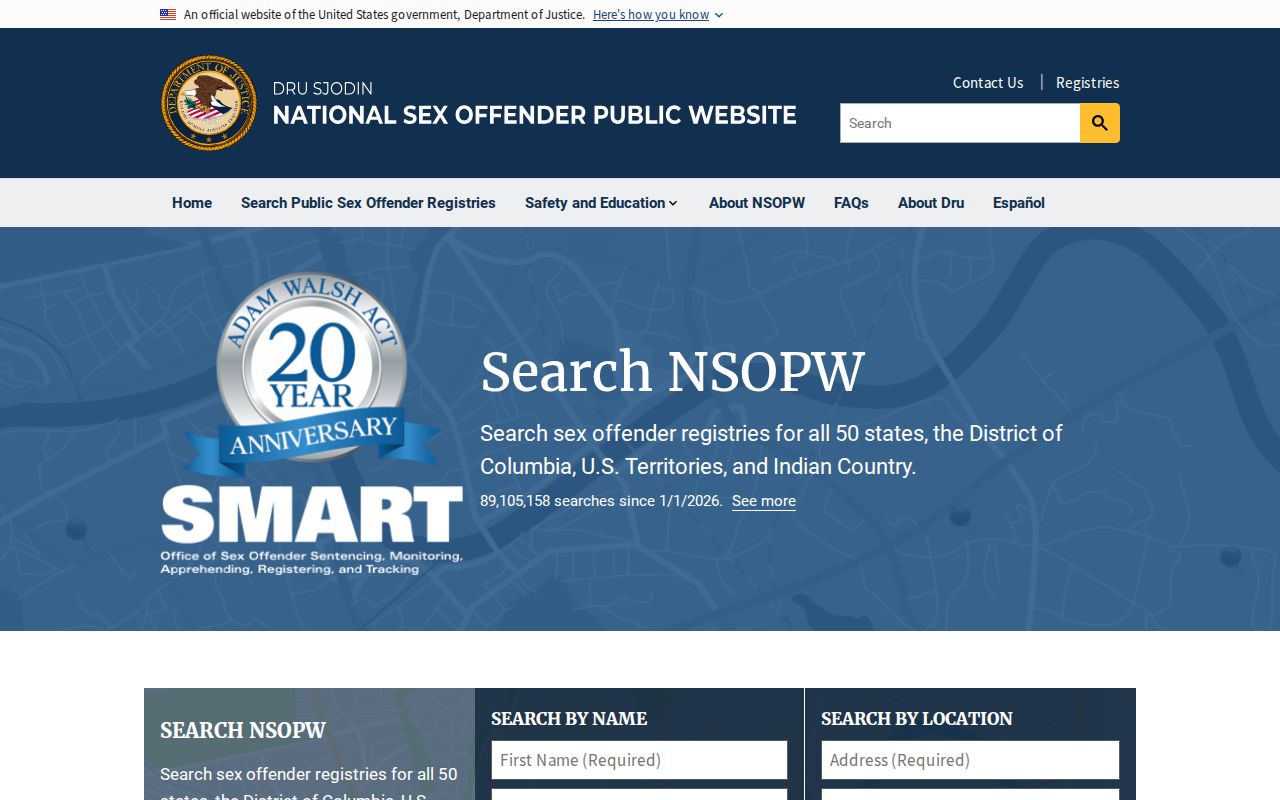
Use NSOPW when a residence or conviction may involve more than one jurisdiction, then confirm a local New Mexico result with the Santa Fe County Sheriff.
Each participating jurisdiction controls what it can release. NSOPW therefore broadens the geographic sweep without making a non-releasable New Mexico classification public. When an address sits near tribal land or a state line, check the national layer and the relevant local registry instead of assuming that one Santa Fe County map covers all systems.
New Mexico Registration Levels and Requirements
New Mexico does not present its current public system as the simple federal Tier I, II, and III chart seen elsewhere. NMDPS identifies registration groups by verification frequency and whether public release is allowed. Duration and frequency turn on the qualifying offense and the conviction or release date. The operative framework generally distinguishes annual registration for 20 years from 90-day registration for life, with repeat qualifying convictions leading to lifetime duties.
| New Mexico classification | Verification | Public point |
|---|---|---|
| 90 Day Re-Registrants | At least every 90 days | Visibility depends on releasability |
| 90 Day Non-Releasable | Every 90 days | Not public |
| Annual Registrants | Annual | Public when the classification qualifies |
| Annual Non-Releasable | Annual | Not public |
| Semi-Annual Non-Releasable | Every six months | Not public |
Proposed legislation is not the rule until enacted. A bill considered in 2026 should not be substituted for the law that governs a current Santa Fe County profile.
NMDPS translates qualifying federal, tribal, military, foreign, and other-state convictions to the closest New Mexico offense. That comparison helps set the duty and verification cycle. The administrative rule provides notice and a way to contest an equivalency, so an out-of-state label should not be mapped to a New Mexico class by guesswork.
Santa Fe County Registry Residence Rules
NMDPS guidance states that New Mexico has no statewide residential-distance ban from schools or day care sites. That does not mean every person has the same freedom to choose a residence. A court order, probation term, or parole condition may impose an individual limit based on the case and supervision status.
Community notice to qualifying schools and day care centers operates under the statutory rules for releasable classifications. Avoid turning that notice rule into a made-up statewide residence radius. For the controlling text, use the official 10.2.3 NMAC registry rule and current NMDPS direction.
Out-of-state, federal, tribal, military, and foreign convictions are translated to the closest New Mexico offense for classification. NMDPS gives notice and a process to contest that equivalency.
Santa Fe County Registration Timing
A person moving into Santa Fe County reports to the county sheriff, who forwards the registration or change to NMDPS. Visitor timing differs by conviction date. NMDPS guidance generally treats cases from before July 1, 2013 as triggering after more than 14 consecutive days or 30 aggregate days, while qualifying cases from July 1, 2013 onward use a five-day rule.
Because the conviction date changes the analysis, it is unsafe to quote one visitor deadline for every person. Registrants should ask the sheriff or NMDPS how the current law applies to their own facts. Knowingly false information and failure to register or verify carry felony consequences under NMSA §29-11A-4.
Community Notification and Lawful Use
The Santa Fe County registry supports informed safety choices. Neighborhood email alerts can notify a subscriber when a registrant moves nearby, and NSOPW can broaden a search across jurisdictions. Use the data to understand a public profile and plan calmly. Registry presence is not evidence of a new offense, and no search result is a license to follow, shame, threaten, or contact a person.
Use registry information lawfully: Misuse can be a crime. The New Mexico Sex Offender Registration and Notification Act, NMSA §§29-11A-1 et seq., does not authorize harassment, threats, intimidation, confrontation, or any crime against a registrant or household.
Report suspected failure to register or a false address to the Santa Fe County Sheriff or NMDPS. Give the agency a link or the profile facts that caused concern. The sheriff, not a private viewer, decides how a reported local change enters the verified Santa Fe County record. For an immediate safety threat, use the proper emergency channel and do not attempt to investigate in person.